
Why Your Garage Floor Deserves a Real Coating
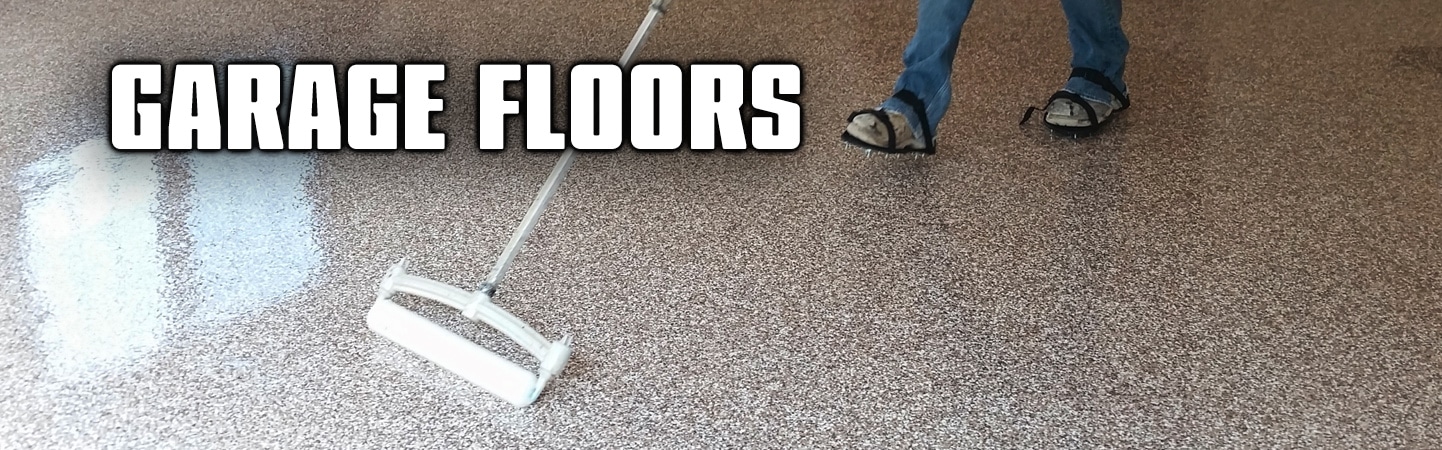
Bare concrete stains, dust, and cracks. It's just what concrete does. A professional-grade garage floor coating stops all of that — you get a seamless, chemical-resistant surface that's easy to clean, looks great, and holds up to hot tires, road salt, oil drips, and whatever else your garage throws at it. Whether you're a homeowner upgrading a two-car garage or a contractor outfitting a commercial shop, the right coating system is the difference between a floor that lasts a couple of years and one that lasts a couple of decades.
We sell the same professional coatings that contractors install on thousands of garage floors every year — packaged in complete DIY concrete-coating kits so you can complete the installation and save a lot of money. Every system below includes everything you need: base coat, color or flakes, and topcoat. We have great instructions and videos to get you through to the finish line.
Which Garage Floor Coating System Is Right for You?
There are three main approaches to coating a garage floor. The right one depends on the look you want, your budget, and how much time you have for the project.
| System Type | Best For | Work Time | Install Time |
|---|---|---|---|
| Decorative Flake Floor | Most popular — hides imperfections, adds texture and color | 20–25 min to extended (varies by kit) | 1–2 days |
| Solid Color Coating | Clean, uniform look at the lowest price point | 45 min (Poly 85 Slow) | 1–2 days |
| Clear Coat / Grind & Seal | Natural concrete look with added protection | 45 min (Poly 85 Slow) | 1–2 days |
Not sure which direction to go? Our garage floor upgrades guide compares all your options side by side — including tiles, rubber, paint, and polished concrete — so you can see how coatings stack up against other approaches.
Decorative Flake Garage Floor Kits
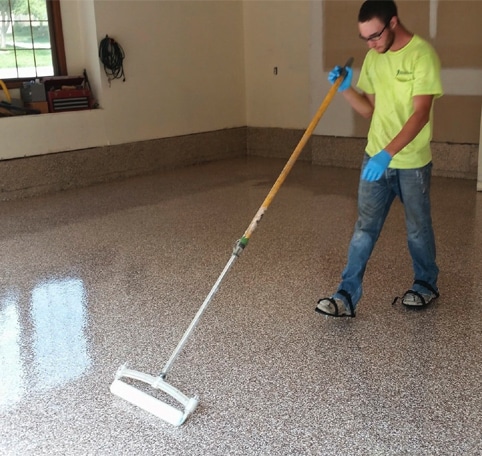
Flake floors are the most popular garage floor coating for a reason. The decorative flakes hide imperfections in the concrete, add slip resistance, and give you a professional, multi-color finish that looks like it cost way more than it did. Every flake kit includes a base coat, 1/4" decorative flakes, and a polyaspartic topcoat — everything you need in one box.
Best for DIY: Epoxy-Poly Flake Kit
Our Epoxy-Poly Flake Kit (which we have nicknamed the "Rookie" system) is the best option for homeowners doing it themselves. It uses our 100% solids Epoxy Flow 100 Slow as the base coat — this stuff gives you the most work time of any system we sell, so you can take your time getting it right. The topcoat is Poly 85 Slow polyaspartic (45 minutes of work time), UV stable, and extremely durable. If you've never coated a floor before, this is the kit to start with.
Kits start at under $1k for up to 400 sq ft, with sizes available up to 2,500 sq ft and beyond.
Best for Speed: Pro One Day Flake Kits
If you're a contractor or experienced installer who wants to get in and out fast, our one-day flake kits are built for speed. The Pro Poly One Day Flake Kit uses Poly 90 for both base and topcoat, while the Pro One Day Flake Kit uses Polybase 98 (a fast-cure polyurea base) with a Poly 90 topcoat. Both let you complete the entire project — base coat, flake broadcast, and topcoat — in a single day. The tradeoff is shorter work time per coat, so these are best for crews that can move quickly.
All flake kits come with your choice of decorative flake colors — 56 color blends to choose from, including popular options like Domino, Orbit, Shoreline, and Nightfall.

Solid Color Garage Floor Coatings
Want a clean, uniform garage floor without the decorative flakes? Our TurnKey Poly Solid Color Kit is a complete polyaspartic system that gives you a single-color finish — UV stable, extremely durable, and about as simple to install as it gets. If you want a clean garage floor without a lot of fuss, this is it.
Kits start at $525 for up to 300 sq ft, with sizes available up to 3000 sq ft. We can customize to any size.Check our garage floor cost guide for a full breakdown by square footage.
The Solid Color Kit uses Poly 85 Slow, so you get a full 45 minutes of work time — plenty of time to coat a standard two-car garage without feeling rushed.
Clear Coat and Grind & Seal Systems
If you like the natural look of your concrete but want to protect it, a clear coat system is the way to go. We offer two options:
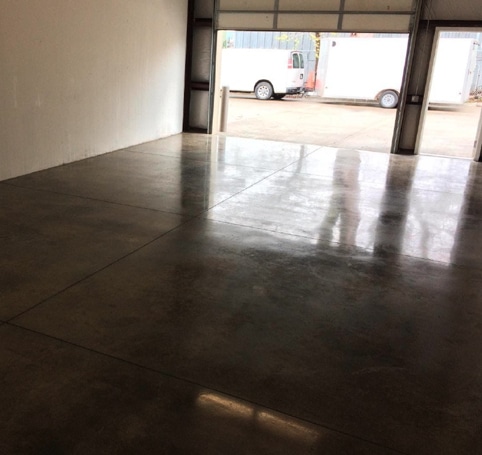
TurnKey Poly Clear Coat Kit — A polyaspartic clear coat system using the same chemistry as our solid color kit, just without the pigment. UV stable, won't yellow, and cures to a high-gloss finish. Great for garages, basements, and shops where you want protection without changing the concrete's look. Contractors call this a "grind and seal."
Level 2 Polished Concrete Kit — A professional-grade mechanical polishing system designed to transform raw concrete into a high-gloss, mirror-like surface. This kit includes a full progression of diamond resin pads, densifier, and protective guard to ensure a durable, wear-resistant finish. Ideal for residential living areas, showrooms, and commercial spaces where you want the premium look and longevity of true polished concrete.
What to Know Before You Coat Your Garage Floor
The single most important factor in how long your garage floor coating lasts is surface prep. Skip this step or do it wrong, and even the best coating will peel.
Diamond Grinding Is Required
Every coating system we sell requires mechanical surface prep — that means diamond grinding your concrete to create a profile the coating can bond to. You're going for a light, broom-like texture. Grinders can be rented from most equipment rental stores for around $200–$400/day.
Important: Never use muriatic acid to prep your garage floor. It doesn't create a proper profile, leaves chemical residue, and is one of the most common causes of DIY floor-coating failures. Always dry grind.
Check for Moisture
Tape a piece of plastic sheeting to the floor and leave it for 24 hours. If moisture collects underneath, you may need our MVB moisture-mitigating primer before applying your coating. This is especially common in older garages and areas with high water tables.
Temperature and Timing
Apply coatings when the concrete and air are between 50°F and 80°F. You can go above 80° — it just speeds up the cure, which means less work time. You can go below 50…it will just be slower. Never go below 40 with an epoxy. Polyaspartics, on the other hand, can be installed below 40 but will take longer to cure. Remember, floor temperature is just as vital as, or more vital than, the current air temperature. For most homeowners, spring and fall are ideal. Plan to keep vehicles off the floor for at least 72 hours after the final coat.
Garage Floor Coating FAQ
How much does it cost to coat a garage floor yourself?
It depends on the system and the size of your garage. Our complete DIY kits start at $500 for a solid-color system and go up from there for decorative-flake floors.We put together a full epoxy garage floor cost breakdown with pricing by garage size, system type, and DIY vs. professional installation.
How long does a garage floor coating last?
A professional-grade polyaspartic or epoxy coating will last 20 years with proper surface prep and normal garage use. Big-box store kits that use water-based epoxy? Typically 1–3 years before they start peeling. The difference is the product chemistry and the prep work.
Can I coat my garage floor myself?
Yes — that's exactly what our kits are designed for. The most important part is surface prep (diamond grinding — don't skip this). The actual coating application is straightforward: mix, pour, squeegee, and roll. Our flake floor installation guide and video gallery walk you through every step.
What is the best coating for a garage floor?
For most homeowners, a decorative flake system is the best overall choice. It's durable, hides concrete imperfections, adds slip resistance, and looks great. If budget is your top priority, a solid-color polyaspartic system delivers professional-grade durability at the lowest cost per square foot. For a deeper comparison of coating types, see our polyaspartic vs epoxy guide.
Do garage floor coatings resist hot tire pickup?
Yes. All of our polyaspartic and polyurea coatings are hot tire resistant — your tires won't pull up or discolor the coating, even after driving on hot pavement. This is one of the biggest advantages over water-based products and standard paint, which frequently fail from hot tire transfer.
How long before I can park on a coated garage floor?
Light foot traffic is typically fine within 24 hours. For vehicles, wait at least 72 hours (3 days) to allow the coating to fully cure. In cooler temperatures, give it a full 5–7 days before parking on it. The extra patience pays off in long-term durability.
Do I need a primer for my garage floor coating?
Our flake floor kits include the base coat, which bonds directly to properly prepared concrete — no separate primer needed. If you have moisture issues, our MVB primer goes down first as a moisture barrier. Primers in this industry are more to help block things like moisture and a possible rising contamination; they are not a replacement for prep. A good profile is always necessary and can't be replaced with a primer.
What's the difference between big-box epoxy kits and professional-grade kits?
Big-box kits ($100–$500) use water-based epoxy that's thinner, less durable, and starts peeling within 1–3 years. Consider it a red flag if a kit uses water-based epoxy as the topcoat. Our kits use 100% solids epoxy and polyaspartic coatings — the same products that contractors install professionally and charge $6 to $9 per sq ft. They're thicker, bond harder, resist more chemicals, and last 10–20 years. You're paying more for materials but saving thousands on labor.
Ready to Coat Your Garage Floor?
Use our coverage calculator to figure out how much product you need, then pick the system that fits your project:
- Epoxy-Poly Flake Kit — Most popular, best for DIY flake floors (slow set products!)
- TurnKey Poly Solid Color Kit — Lowest cost, clean single-color finish
- TurnKey Poly Clear Coat Kit — Protect concrete without changing the look
- Polished Concrete Level 2 Kit — Professional diamond polishing system for a durable, high-gloss mirror finish
- Pro One Day Flake Kits — Fast-cure systems for contractors and pros
Questions? Contact us — we help homeowners and contractors pick the right system every day.